
Rhinoplasty Course Explained: Skills, Training, and Career Benefits
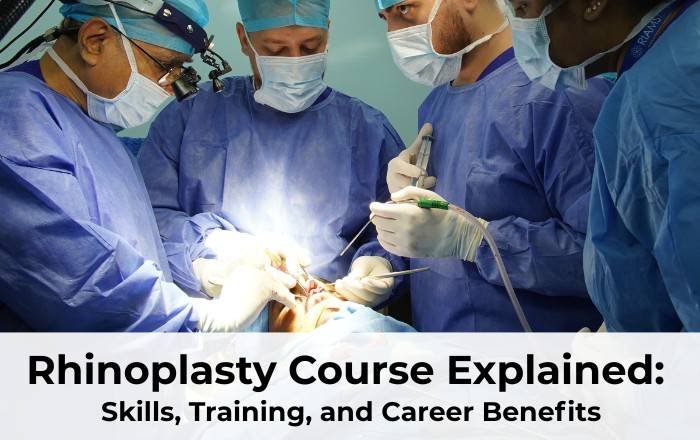
Rhinoplasty Course Explained: Skills, Training, and Career Benefits
 Riams
Riams As demand for functional and aesthetic nasal surgery continues to rise worldwide, surgeons are increasingly seeking specialized education to enhance their rhinoplasty expertise. A structured Rhinoplasty Course provides focused training in nasal anatomy, surgical planning, patient assessment, and modern rhinoplasty techniques.
Whether you are an otorhinolaryngologist, facial plastic surgeon, or aesthetic surgeon, a well-designed rhinoplasty training program can help bridge the gap between theoretical knowledge and clinical application.
Today, surgeons can choose from various learning pathways, including an Advanced Rhinoplasty Course, Rhinoplasty Fellowship, Preservation Rhinoplasty Course, and specialized ENT Rhinoplasty Training programs. Understanding these options is essential for selecting the right educational pathway.
Looking to strengthen your skills in modern nasal surgery?
Key Takeaways
- A Rhinoplasty Course teaches modern nasal surgery techniques.
- Surgeons gain expertise in both cosmetic and functional rhinoplasty.
- Advanced programs focus on complex revision and preservation techniques.
- In OT Assistance enhances procedural confidence and surgical decision-making.
- Rhinoplasty Fellowships provide longer-term immersive learning.
- Specialized training improves patient outcomes and professional growth.
- Preservation Rhinoplasty is becoming increasingly popular worldwide.
- Selecting an accredited course ensures better educational value.
What Is a Rhinoplasty Course?
A Rhinoplasty Course is a structured educational program designed to teach surgeons the principles and techniques involved in nasal surgery.
These courses typically cover:
Nasal Anatomy and Physiology
- Functional anatomy
- Structural support mechanisms
- Nasal airflow dynamics
- Facial harmony principles
Patient Evaluation
- Clinical assessment
- Facial analysis
- Surgical planning
- Digital imaging and simulation
Surgical Techniques
- Open rhinoplasty
- Closed rhinoplasty
- Structural rhinoplasty
- Preservation rhinoplasty
- Revision rhinoplasty
The primary objective is to develop surgical competence while improving both functional and aesthetic outcomes.
Who Should Join a Rhinoplasty Course?
A rhinoplasty training program is particularly valuable for:
Otorhinolaryngologists (MS, DNB, DLO)
ENT surgeons frequently manage nasal airway problems and can benefit from advanced cosmetic and reconstructive techniques.
Plastic Surgeons (MCh, DNB)
Plastic surgeons seeking facial aesthetic specialization often pursue dedicated rhinoplasty education.
Facial Plastic Surgeons
These specialists can expand expertise in complex primary and revision cases.
Early-Career Surgeons
Structured education accelerates learning and reduces the challenges associated with self-directed surgical development.
How Can a Rhinoplasty Training Course Improve Surgical Skills?
Enhanced Anatomical Understanding
Successful rhinoplasty requires a detailed understanding of:
- Nasal framework
- Cartilage dynamics
- Soft tissue behavior
- Airway preservation
Training programs strengthen this foundational knowledge.
Better Surgical Planning
Surgeons learn:
- Case selection
- Risk assessment
- Procedural sequencing
- Customized treatment planning
In OT Assistance Exposure
One of the most valuable aspects of quality training is observing expert surgeons and participating through In OT Assistance, allowing learners to understand procedural nuances and decision-making processes.
Improved Complication Management
Courses often address:
- Secondary deformities
- Airway compromise
- Scar management
- Revision strategies
This knowledge contributes to safer surgical outcomes.
What Techniques Are Taught in an Advanced Rhinoplasty Course?
An Advanced Rhinoplasty Course generally focuses on sophisticated procedures beyond foundational training.
Structural Rhinoplasty
Topics include:
- Cartilage grafting
- Septal reconstruction
- Tip support techniques
- Dorsal augmentation
Revision Rhinoplasty
Surgeons learn how to:
- Correct previous surgical outcomes
- Restore nasal function
- Manage scarred tissue
Ethnic Rhinoplasty
Training covers:
- Cultural aesthetic considerations
- Anatomical variations
- Customized surgical approaches
Ultrasonic Rhinoplasty
Modern courses increasingly teach:
- Piezoelectric instrumentation
- Precision osteotomies
- Reduced soft tissue trauma
How Does Preservation Rhinoplasty Training Differ From Traditional Rhinoplasty Training?
Preservation Rhinoplasty emphasizes maintaining native nasal structures whenever possible.
Traditional Rhinoplasty
Often involves:
- Dorsal hump removal
- Structural modification
- Reconstructive grafting
Preservation Rhinoplasty
Focuses on:
- Preserving dorsal anatomy
- Maintaining ligament support
- Minimizing tissue disruption
- Improving recovery experience
Benefits
- More natural outcomes
- Reduced postoperative swelling
- Improved structural integrity
- Enhanced patient satisfaction
As global trends continue shifting toward preservation techniques, specialized training is becoming increasingly important.
Why Is ENT Rhinoplasty Training Important for Surgeons?
ENT specialists frequently manage both functional and aesthetic concerns.
Dedicated ENT Rhinoplasty Training helps surgeons:
- Improve airway-focused outcomes
- Understand septal reconstruction
- Address nasal obstruction
- Combine functional and cosmetic procedures
This integrated approach often results in better patient care and broader clinical capabilities.
What Should Surgeons Look for Before Enrolling in a Rhinoplasty Course?
Faculty Expertise
Choose programs led by recognized rhinoplasty educators with substantial surgical experience.
Curriculum Quality
The course should cover:
- Anatomy
- Planning
- Surgical techniques
- Complication management
- Revision surgery
In OT Assistance Opportunities
Programs that include observation and participation through In OT Assistance provide valuable procedural insights.
Evidence-Based Education
Look for programs emphasizing:
- Scientific literature
- Current best practices
- Long-term outcome analysis
Global Recognition
Internationally rhinoplasty course enhances credibility and professional networking opportunities.
Career Benefits of Completing a Rhinoplasty Course.
Expanded Clinical Services
Surgeons can offer:
- Cosmetic rhinoplasty
- Functional rhinoplasty
- Revision procedures
Increased Professional Confidence
Specialized training improves decision-making and surgical execution.
Greater Referral Opportunities
Advanced expertise often leads to:
- More referrals
- Improved reputation
- Increased patient trust
Enhanced Academic Growth
Many surgeons leverage training for:
- Teaching roles
- Research opportunities
- Conference participation
Competitive Advantage
As patient demand grows, specialized rhinoplasty expertise differentiates surgeons in a competitive healthcare market.
Statistics and Data.
Recent industry observations indicate:
- Rhinoplasty remains one of the most frequently performed facial plastic surgery procedures globally.
- Demand for preservation rhinoplasty techniques has increased significantly over the last decade.
- Surgeons with specialized rhinoplasty education often report improved procedural confidence and patient satisfaction.
- Functional rhinoplasty procedures continue growing due to increasing awareness of nasal airway health.
Expert Insights
“Modern rhinoplasty education should focus not only on surgical techniques but also on patient analysis, functional preservation, and long-term outcomes.”
The most successful surgeons combine anatomical knowledge, procedural precision, and continuous professional education.
Conclusion
A comprehensive Rhinoplasty Course can significantly accelerate a surgeon’s professional development by improving technical knowledge, surgical planning, and procedural confidence. Whether pursuing an Advanced Rhinoplasty Course, Preservation Rhinoplasty Course, ENT Rhinoplasty Training, or a full Rhinoplasty Fellowship, structured education remains one of the most effective ways to build expertise in modern nasal surgery.
As rhinoplasty techniques continue to evolve, continuous learning is essential for delivering outstanding functional and aesthetic outcomes.
Frequently Asked Questions.
What is a Rhinoplasty Course?
A Rhinoplasty Course is a specialized surgical training program focused on cosmetic and functional nasal surgery techniques.
Who should attend a Rhinoplasty Training Course?
ENT surgeons, plastic surgeons, facial plastic surgeons, and doctors interested in nasal surgery.
What is taught in an Advanced Rhinoplasty Course?
Advanced courses cover revision rhinoplasty, structural rhinoplasty, preservation techniques, grafting, and complex case management.
Is a Rhinoplasty Fellowship better than a Rhinoplasty Course?
A fellowship provides long-term immersive training, while a course offers focused skill enhancement in a shorter timeframe.
Why is Preservation Rhinoplasty gaining popularity?
Because it preserves natural nasal structures, often leading to improved outcomes and reduced tissue disruption.
How important is In OT Assistance during training?
In OT Assistance allows surgeons to observe expert techniques, understand procedural workflows, and strengthen clinical decision-making.