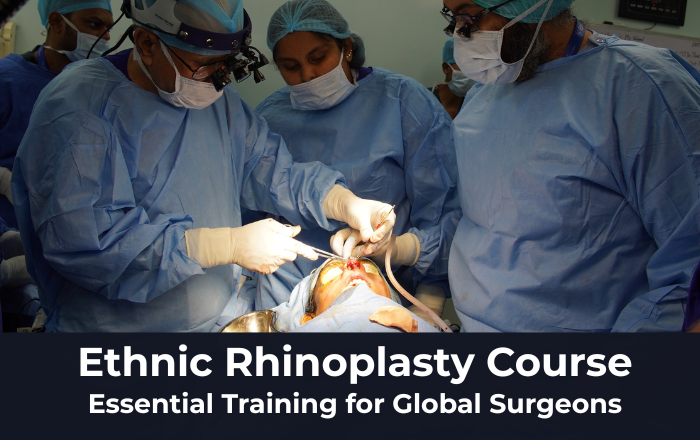
As patient populations become increasingly diverse, surgeons must develop advanced skills to address the unique anatomical and aesthetic considerations associated with ethnic rhinoplasty. An Ethnic Rhinoplasty Course provides specialized education that helps ENT surgeons, facial plastic surgeons, and aesthetic surgeons achieve predictable outcomes while preserving ethnic identity.
Unlike traditional rhinoplasty training, these courses focus on nasal structures commonly encountered in patients from African, Asian, Middle Eastern, Hispanic, and other ethnic backgrounds. Through structured learning, cadaveric exposure, live surgical observation, and In OT Assistance, surgeons gain valuable insights into modern rhinoplasty techniques that prioritize both function and aesthetics.
For surgeons seeking to elevate their expertise, an advanced Rhinoplasty Course can become a critical step toward professional growth and improved patient outcomes.
Ready to elevate your surgical skills?
Key Takeaways
Ethnic rhinoplasty requires specialized surgical knowledge.
A Rhinoplasty Course helps surgeons master advanced nasal reconstruction techniques.
Preservation rhinoplasty concepts are increasingly incorporated into modern training.
In OT Assistance enhances practical surgical understanding.
Rhinoplasty training can improve patient satisfaction and surgical confidence.
Surgeons can choose between a Rhinoplasty Fellowship and focused course-based learning depending on career goals.
Advanced training supports both aesthetic and functional nasal surgery.
The Evolution of Ethnic Rhinoplasty Training.
Ethnic rhinoplasty education has changed significantly over the past two decades. Earlier approaches often focused on reducing nasal size using standard reduction techniques. While these methods could alter the appearance of the nose, they frequently overlooked structural support, airway function, and the patient’s natural ethnic characteristics.
Today’s advanced training introduces surgeons to:
Structural Rhinoplasty
Preservation Rhinoplasty
Functional Rhinoplasty
Hybrid Surgical Techniques
Cartilage Preservation Strategies
Modern surgical education teaches doctors how to maintain nasal stability while creating refined, natural-looking results that respect individual ethnic features.
What Is an Ethnic Rhinoplasty Course?
An Ethnic Rhinoplasty Course is a specialized educational program designed to teach surgeons how to perform rhinoplasty procedures while respecting and preserving ethnic facial characteristics.
Direct Answer
An ethnic rhinoplasty course trains surgeons to address anatomical variations across different ethnic groups while achieving functional and aesthetic improvements.
Common Topics Covered
Nasal anatomy variations
Structural grafting techniques
Septal correction
Tip refinement
Dorsal augmentation
Functional airway preservation
Preservation rhinoplasty concepts
Revision rhinoplasty management
Patient consultation and planning
Understanding Ethnic Nasal Anatomy
Successful surgery begins with a thorough understanding of anatomy. Every ethnic group presents unique anatomical characteristics that influence surgical planning and execution.
An advanced Ethnic Rhinoplasty Course helps surgeons evaluate:
Skin thickness
Cartilage strength
Nasal bone shape
Septal support
Internal nasal valve
Facial proportions
Soft tissue envelope
Airway anatomy
Rather than applying identical techniques to every patient, surgeons learn how anatomical differences affect surgical decision-making and postoperative healing.
Why Specialized Ethnic Rhinoplasty Training Matters?
Different ethnic populations often present distinct anatomical features that influence surgical planning.
Ethnic GroupCommon ConsiderationsAsianLow dorsum, thick skinAfricanWide alar base, weaker cartilageMiddle EasternProminent dorsal humpHispanicVariable anatomy requiring individualized planningSouth AsianMixed structural characteristics
Understanding these differences helps surgeons create personalized treatment plans rather than applying a one-size-fits-all approach.
Modern rhinoplasty emphasizes preservation of identity while enhancing facial harmony.
Core Techniques Taught in an Advanced Rhinoplasty Course.
Structural Rhinoplasty
Focuses on strengthening nasal support systems using grafts and cartilage reconstruction.
Topics Include
Septal extension grafts
Columellar struts
Spreader grafts
Alar batten grafts
Preservation Rhinoplasty in Ethnic Patients.
Preservation Rhinoplasty has become an important part of modern rhinoplasty education. Instead of removing large amounts of bone and cartilage, preservation techniques focus on maintaining native nasal structures whenever appropriate.
Training includes:
Dorsal preservation
Ligament preservation
Soft tissue preservation
Internal nasal valve protection
Controlled dorsal lowering
Long-term structural stability
These principles help surgeons achieve natural aesthetic outcomes while reducing unnecessary tissue disruption and preserving nasal function.
International Faculty and Global Surgical Perspectives.
One of the greatest advantages of an advanced Ethnic Rhinoplasty Course is exposure to internationally recognised faculty members. Surgeons from different regions often encounter unique anatomical variations and have developed specialised techniques based on their patient populations.
Participants gain insights into approaches for:
Asian rhinoplasty
Middle Eastern rhinoplasty
African rhinoplasty
Hispanic rhinoplasty
South Asian rhinoplasty
Mixed-ethnicity rhinoplasty
Learning from experienced international faculty broadens surgical thinking and helps participants understand multiple operative philosophies that can be adapted to individual patients.
Why In OT Assistance Is Essential During Training?
Surgical mastery requires more than lectures and theoretical education.
Through In OT Assistance, participants can:
Observe expert decision-making
Understand real-time anatomy
Learn operative workflow
Improve graft placement techniques
Recognize complication management strategies
Develop procedural confidence
This practical exposure bridges the gap between classroom knowledge and surgical execution.
Cadaveric Dissection: Building Anatomical Confidence
A detailed understanding of anatomy cannot rely solely on textbooks or presentations. Cadaveric dissection workshops provide an opportunity to study nasal structures in three dimensions before performing surgery on patients.
During dissection sessions, surgeons learn to:
Identify critical anatomical landmarks
Understand tissue layers
Practice safe dissection techniques
Explore cartilage harvesting
Improve instrument handling
Develop confidence in surgical anatomy
This experience strengthens anatomical knowledge and supports safer operative performance.
Statistics and Industry Data
Global Trends
Rhinoplasty consistently ranks among the most commonly performed facial plastic surgery procedures worldwide.
Demand for ethnic rhinoplasty continues to grow as patients seek culturally sensitive aesthetic outcomes.
Functional rhinoplasty procedures are increasing due to greater awareness of nasal airway disorders.
Surgeons with specialized training often report greater confidence in managing complex nasal anatomy.
Training Trends
Medical education organizations worldwide are increasingly incorporating:
Preservation rhinoplasty
Functional rhinoplasty
Revision rhinoplasty
Ethnic rhinoplasty principles
into modern continuing surgical education programs.
Learning Through Live Surgery Observation.
Observing experienced surgeons during live procedures offers valuable insight into real-time clinical decision-making. Rather than following a fixed surgical plan, participants witness how experts adapt techniques to individual anatomical findings encountered during surgery.
Live surgery sessions may demonstrate:
Preoperative planning
Intraoperative assessment
Graft selection
Tip refinement
Osteotomy planning
Airway preservation
Managing unexpected anatomical challenges
Understanding why surgical decisions change during an operation helps participants develop sound clinical judgement.
Case-Based Learning and Surgical Decision-Making.
No two rhinoplasty patients are identical. Case-based discussions encourage surgeons to evaluate multiple treatment options before selecting the most appropriate surgical strategy.
Training often includes cases involving:
Thick skin noses
Thin skin noses
Crooked noses
Saddle nose deformities
Wide nasal base
Dorsal humps
Revision rhinoplasty
Functional nasal obstruction
By analysing real clinical scenarios, participants learn how anatomy, patient expectations, and long-term stability influence treatment planning.
Functional Rhinoplasty: Preserving Breathing While Improving Appearance
Modern rhinoplasty education recognises that successful outcomes depend on both aesthetic improvement and functional preservation. An attractive nose should also support comfortable nasal breathing.
Comprehensive training includes assessment of:
Internal nasal valve
External nasal valve
Septal deviation
Inferior turbinate hypertrophy
Airflow dynamics
Structural support mechanisms
Understanding functional anatomy enables surgeons to avoid compromising nasal airflow while achieving aesthetic goals.
Treating Diverse Patient Populations.
Global surgeons increasingly care for patients from different ethnic backgrounds. Each population presents unique anatomical considerations that require tailored surgical planning.
An Ethnic Rhinoplasty Course prepares participants to evaluate:
Asian nasal anatomy
African nasal characteristics
Middle Eastern nasal structure
Hispanic nasal features
Indian nasal variations
Mixed-ethnicity anatomy
Rather than pursuing a standardised appearance, surgeons learn to preserve cultural identity while enhancing facial balance and nasal function.
Long-Term Stability and Surgical Success.
Immediate postoperative photographs do not fully reflect the success of rhinoplasty. Long-term stability remains one of the most important indicators of quality surgical outcomes.
Advanced training focuses on:
Scar maturation
Cartilage stability
Swelling resolution
Structural preservation
Airway maintenance
Revision prevention
Patient satisfaction over time
By understanding the biological processes that continue after surgery, surgeons can make intraoperative decisions that support durable functional and aesthetic results.
Why Continuous Learning Matters?
Ethnic rhinoplasty continues to evolve through research, technological advances, and shared international experience. Surgeons who participate in ongoing education remain better prepared to adopt evidence-based techniques and refine their surgical judgement.
An advanced Ethnic Rhinoplasty Course offers far more than technical instruction. It develops analytical thinking, strengthens anatomical understanding, enhances operative planning, and exposes participants to diverse surgical philosophies through expert mentorship, case discussions, cadaveric dissection, and live surgical observation. These experiences help surgeons deliver personalised, natural-looking, and functionally stable outcomes for patients from a wide range of ethnic backgrounds.
Expert Insights
Key Insight
“The future of rhinoplasty lies in individualized surgical planning that respects ethnic identity while improving form and function.”
Modern surgeons are expected to combine technical precision with cultural awareness. Specialized rhinoplasty education helps achieve this balance and supports better patient-centered outcomes.
Conclusion
An Ethnic Rhinoplasty Course is becoming an essential component of modern surgical education. As patient expectations evolve and global diversity increases, surgeons must develop the expertise required to deliver personalized, culturally sensitive outcomes.
Whether through a focused Rhinoplasty Training Course, an Advanced Rhinoplasty Course, or a comprehensive Rhinoplasty Fellowship, continued education remains critical for achieving excellence in nasal surgery.
By combining evidence-based techniques, preservation principles, and In OT Assistance, surgeons can strengthen their skills and provide better care for patients worldwide.
FAQ Section
What makes ethnic rhinoplasty different from standard rhinoplasty?
Ethnic rhinoplasty considers anatomical differences, skin characteristics, cartilage strength, and cultural aesthetic preferences to create personalised surgical plans while preserving ethnic identity.
Why is preservation rhinoplasty important in ethnic patients?
Preservation techniques maintain important nasal structures, support long-term stability, reduce tissue trauma, and help achieve natural-looking results.
Who should attend an Ethnic Rhinoplasty Course?
The course is suitable for ENT surgeons, facial plastic surgeons, plastic surgeons, and clinicians who wish to improve their understanding of ethnic nasal anatomy and modern rhinoplasty techniques.
Does the course include functional rhinoplasty concepts?
Yes. Comprehensive training typically covers airway assessment, septal support, internal nasal valve preservation, and techniques that maintain both breathing function and aesthetic outcomes.
How does case-based learning improve surgical skills?
Analysing real patient cases helps surgeons understand clinical reasoning, compare treatment options, anticipate challenges, and develop better decision-making skills before entering the operating theatre.
What is an Ethnic Rhinoplasty Course?
It is a specialized surgical training program that teaches rhinoplasty techniques tailored to diverse ethnic anatomies while preserving cultural identity.
Who should attend a Rhinoplasty Course?
ENT surgeons, plastic surgeons, facial plastic surgeons, and doctors interested in nasal surgery.
What is taught in an Advanced Rhinoplasty Course?
Participants learn structural rhinoplasty, preservation rhinoplasty, revision surgery, functional rhinoplasty, and ethnic-specific surgical techniques.
Is a Rhinoplasty Fellowship better than a course?
Both have value. Courses provide focused skill development, while fellowships offer long-term immersive training.
Why is In OT Assistance important?
It allows surgeons to observe procedures directly, understand anatomy in real clinical settings, and improve surgical decision-making.
What are the career benefits of rhinoplasty training?
Benefits include enhanced expertise, improved patient outcomes, greater confidence, expanded surgical services, and stronger professional credibility.
Recon Institute of Aesthetic Medicine & Surgery
Recon Institute of Aesthetic Medicine & Surgery publishes structured academic resources for surgeons in rhinoplasty and facial aesthetics.
Published May 27, 2026